
 Surveillance
 Matrimonial Investigations
 Bug Sweeping
 GPS Vehicle Tracking
 Lie Detector Test
 Person Tracing
 Employee Investigations
 Asset Tracing
 Fraud Investigations
 Injury & Insurance Investigations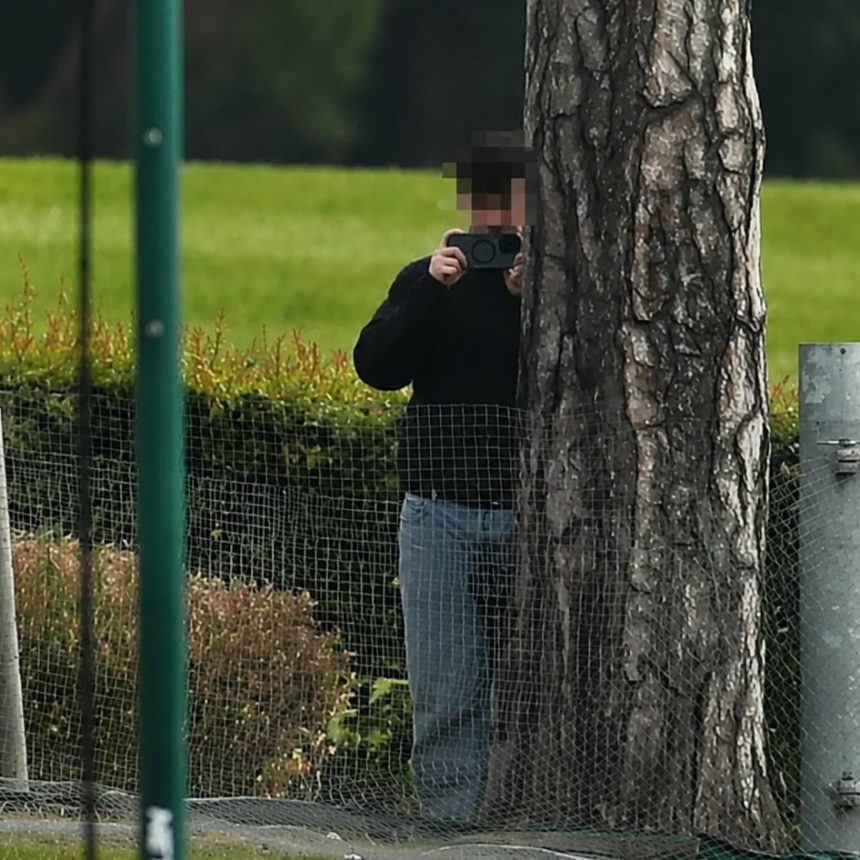
What is Spygate and what have Southampton done?
Spygate has stolen the headlines and potentially crushed Southamptons chances of promotion. The image is difficult to forget. A figure partially concealed behind a tree, mobile phone raised in landscape mode, filming from the edge of a training ground. Whatever the full facts turn out to be, the photograph that emerged from Middlesbrough’s Rockliffe Park facility in May 2026 has already done considerable damage — to a club’s reputation, to the integrity of the Championship play-offs, and to the individual caught in the frame.
Southampton Football Club has been charged by the English Football League with breaching two regulations: Regulation 3.4, which requires clubs to act towards each other with utmost good faith, and Regulation 127, which prohibits any club from observing — or attempting to observe — another club’s training session within 72 hours of a scheduled match. An Independent Disciplinary Commission will determine the outcome. The timing, with a Wembley final at stake, could not be more consequential.
But beyond this offence, other Championship clubs are now scrambling through CCTV footage to see if they have been a victim of Spygate. This episode raises questions that extend well outside the Championship. For any organisation considering how to gather intelligence on a competitor — and how not to — there are serious lessons here worth examining.
The EFL 72-Hour Rule: What It Is and Why It Exists
EFL Regulation 127 was introduced in 2019 in direct response to the original “Spygate” involving Marcelo Bielsa’s Leeds United, after a member of Bielsa’s staff was caught filming a Derby County training session. Leeds were fined £200,000 and received a formal reprimand, with the EFL concluding their conduct fell significantly short of the standards expected.
What made the Leeds case remarkable was not just the act itself, but Bielsa’s response to being caught. He openly admitted he had sent scouts to observe every opponent that season and invited the press in to see the depth of his analysis. The governing body had no choice but to close the regulatory gap. The regulation now explicitly states that no club shall “directly or indirectly observe, or attempt to observe, another club’s training session in the period of 72 hours prior to any match scheduled to be played between those respective clubs.”
The rule exists for a straightforward reason: a training session in the 72 hours before a match is where a manager’s tactical hand is most clearly shown. Formation changes, set-piece rehearsals, the fitness status of key players — all of it is commercially and competitively sensitive. Observing it without consent is not creative scouting. Southampton are the first club to face charges under Regulation 127 directly, and the disciplinary commission’s decision will set a significant precedent.
Spygate Isn’t a New Problem — It Just Has a New Postcode
Anybody who has watched the Netflix documentary Untold: Sign Stealer will recognise the blueprint. The documentary chronicles the scandal that consumed American college football in 2023, when Michigan analyst Connor Stalions was accused of orchestrating a systematic operation to steal opposition hand signals. Stalions allegedly purchased tickets to more than thirty games against Michigan opponents, with seats positioned on the 50-yard line approximately two rows back, giving scouts a clear line of sight to opposition coaches’ sideline signals. Footage was captured, a database of thousands of signals was constructed, and a competitive advantage was built from it.
The parallel with the Southampton allegations is clear. Different sport, different continent, different rulebook — but the same underlying logic: gain advance sight of what your opponent is planning to do. The Michigan fallout was severe: the programme was stripped of postseason revenue, handed significant financial penalties, and the then-head coach Jim Harbaugh received a ten-year show cause finding.
The lesson is not simply that the scheme was discovered. It is that operating at the edge of — or beyond — the rules created a scandal that dwarfed any competitive advantage that could have been gained.
Why DIY Surveillance Almost Always Goes Wrong — and Why a Private Investigator Would Never Proceed
The figure behind the tree at Rockliffe Park was, according to reports, not a seasoned operative. The person alleged to have filmed Middlesbrough’s session has been identified as an intern analyst who reportedly used a personal bank card at a nearby facility, leaving a digital trail. Middlesbrough are said to hold CCTV footage of the alleged intruder, and the individual was captured in a published photograph standing half-concealed, phone raised.
This is the consistent pattern when organisations attempt covert surveillance without proper planning, legal oversight, or professional tradecraft. Without prior assessment of the operational environment, basic errors occur: visible positioning, traceable purchases, digital footprints, and no contingency for being observed. Evidence gathered this way — even if the underlying intelligence is accurate — may be inadmissible in any subsequent proceeding and is almost certain to cause reputational damage if discovered. In a high-profile environment like professional football, it will be discovered.
There is also a legal dimension frequently overlooked. Filming individuals on private property without consent raises questions under data protection legislation and the right to privacy. The location, timing, and relationship between the parties all matter — and none of those questions tend to be considered by someone tasked informally with “going to have a look.”
A legitimate interest assessment — the standard first step for any professional, proportionate investigation — would have raised immediate flags here. In the context of two EFL clubs preparing for a play-off semi-final, Regulation 127 represents an explicit prohibition. There is no lawful basis on which observing a rival’s private training session within 72 hours of a fixture can be framed as proportionate or compliant with the good faith obligations both clubs have accepted as league members.
Any competent private investigator instructed to advise in this context would not proceed. The activity as described constitutes what any reasonable assessment would identify as a clear violation of competitive regulations — and, depending on method and location, conduct that could reasonably be characterised as corporate espionage.
Will Southampton Lose Their Place in the Play-off’s Because of Spygate?
Southampton face sanctions ranging from a financial penalty to exclusion from the play-off final entirely, according to Sky Sports. The Independent Disciplinary Commission has full independence to determine the appropriate outcome. Sources have indicated Middlesbrough would push for the sternest possible sanction.
Whatever the commission decides, the reputational damage is already done. The image of an analyst concealed behind a tree is now part of the club’s public record. The manager walked out of press conferences. The question “are you a cheat?” was put, on camera, to the head coach. That is not recoverable by winning a Wembley final.
This is the arithmetic of poorly executed intelligence work: the upside is marginal — tactical information that may or may not have influenced a result — and the downside is severe and permanent. A professional assessment of proportionality would have identified this before anyone got on a train to Middlesbrough.
When to Instruct a Private Detective — and What Lawful Intelligence Gathering Actually Looks Like
The context here is sport, but the principle applies across any competitive or commercial environment. When an organisation believes it has a legitimate intelligence-gathering need, the question is not whether to act. The question is how to act in a way that is lawful, proportionate, and capable of producing evidence that can be used.
That means proper instruction, documented purpose, a clear legal basis, and methods that can withstand scrutiny. It means thinking, before anything else, about what happens if the activity is discovered.
We have worked with Premier League clubs on exactly this kind of sensitive brief. In our brand protection and counterfeit merchandise investigations, the approach begins in the same place every time: a clear assessment of what is lawful, what is proportionate, and what the evidence needs to do. That framework is what separates intelligence gathering that protects an organisation from intelligence gathering that destroys it.
No professional private investigator would have sent an intern analyst to film from a tree line. And no properly instructed investigation would have ended up on the front pages.
What is Spygate?
What is the EFL 72-hour rule and how does it apply to observing training?
EFL Regulation 127 prohibits any club from observing — or attempting to observe — another club’s training session in the 72 hours immediately prior to a scheduled fixture between the two clubs. It was introduced in 2019 following the Leeds United/Derby County incident, when the existing good faith regulation (Regulation 3.4) was used to fine Leeds £200,000. Regulation 127 made the prohibition explicit. Southampton are the first club to be charged directly under it.
What sanctions could Southampton face?
As Sky Sports has reported, the Independent Disciplinary Commission can impose anything from a dismissed charge to a financial penalty, a sporting sanction, or expulsion from the play-offs. There is no settled precedent under Regulation 127, which makes this case significant for the EFL’s regulatory framework as a whole.
Why do DIY surveillance attempts and informal investigations usually go wrong?
Without proper operational planning, legal assessment, and professional tradecraft, fundamental errors occur and spygate headlines loom — visible positioning, traceable digital activity, CCTV exposure, no considered response to being observed. Evidence gathered through undocumented or legally uncertain means is often inadmissible in any subsequent process, and creates immediate reputational exposure if discovered.
Is filming or observing training always prohibited, or does it depend on timing and location?
The 72-hour prohibition is absolute within the EFL context for the clubs involved in a scheduled fixture. Outside that window, other considerations apply — whether the property is private, whether consent has been given, and whether the activity is proportionate to the claimed purpose. In all cases, filming individuals on private property raises data protection and privacy questions that require legal assessment before anything begins.
When should an organisation instruct a private investigator rather than handle intelligence gathering internally?
Whenever the activity involves gathering information about individuals or organisations on private property, or where the output needs to withstand scrutiny in a formal process. A professional private investigator will assess lawful basis and proportionality before any operational activity, document the instruction and methodology, and ensure that evidence gathered is capable of being used. If an organisation cannot clearly articulate the lawful basis for what it is considering, it should seek professional advice before proceeding.
If your organisation has a legitimate intelligence-gathering requirement — in sport, in business, or in any context where evidence needs to withstand scrutiny — we would welcome a confidential conversation. Contact us to discuss how a lawful, proportionate approach can protect both your interests, your reputation and keep you out of Spygate headlines.